Waterloo Kitchener Cambridge Stratford Brantford Guelph & Surrounding Areas
Why Hornets Are in a Different Category Than Other Stinging
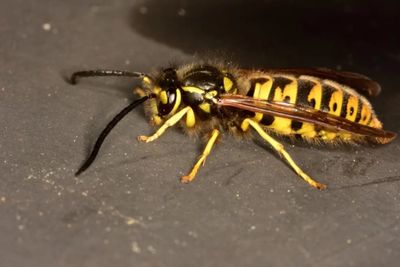
Every stinging insect deserves respect. Hornets require a different level of caution than most.
They defend a large territory around the nest
Hornets do not just protect the nest itself. They respond aggressively to perceived threats in the surrounding area, which can extend several metres from the nest location. You do not have to disturb the nest directly to trigger a response.
They can sting repeatedly
Like wasps, hornets are not limited to a single sting. A disturbed colony will send multiple workers in pursuit of a threat, and each of those workers can sting repeatedly. A full colony response near a person with a venom allergy is a medical emergency.
Their nests are often discovered at the worst possible time
Hornet nests in trees, shrubs, and on structural overhangs are often hidden by foliage through spring and early summer and only become visible in late summer and fall when leaves begin to drop or vegetation is cut back. By that point the colony is at or near peak size, which is when it is most dangerous to approach.
Vibration and noise provoke them
Hornets are sensitive to vibration. Lawn mowers, hedge trimmers, and power tools operating near a nest can trigger an aggressive response even without direct contact with the nest. This is one of the most common ways people accidentally disturb a hornet colony.
Stings pose a serious medical risk for sensitized individuals
For anyone with a known venom allergy, a single hornet sting can trigger anaphylaxis. Even people without a history of severe reactions can develop one over time. A nest anywhere near a regularly used area of your property is not a risk worth managing yourself.
Hornet Species Found in Kitchener & Waterloo
Bald-Faced Hornet
Bald-Faced Hornet
Bald-Faced Hornet

Despite the name, the bald-faced hornet is technically a member of the yellowjacket family rather than a true hornet. It is larger than a standard yellowjacket, black and white in colouring, and among the most aggressive stinging insects found in Ontario. Bald-faced hornets build the large, distinctive grey paper nests commonly seen hanging from tree branches, eaves, utility lines, and roof overhangs. Nests are roughly the size of a softball in early summer and can grow to basketball size or larger by September.
European Hornet
Bald-Faced Hornet
Bald-Faced Hornet
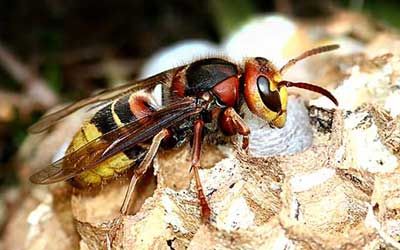
The only true hornet species established in Ontario. European hornets are large, about 25 to 35mm, and brown and yellow in colouring, distinguishing them from the black and white bald-faced hornet. They build papery nests inside hollow trees, wall voids, attic spaces, and outbuildings rather than in the open aerial nests the bald-faced hornet builds. This means European hornet nests are often discovered inside a structure rather than hanging visibly outside.
Where Hornets Build Nests in Waterloo Region
Knowing where to look is part of what makes a thorough inspection valuable. Hornet nests in the Kitchener and Waterloo area are most commonly found in the following locations.
Trees and shrubs. Bald-faced hornets frequently build aerial nests in trees, hedges, and ornamental shrubs. Nests hidden by foliage in summer often go undetected until the surrounding leaves drop in fall, by which point the colony is at its largest.
Eaves, soffits, and roof overhangs. Sheltered structural overhangs provide ideal attachment points for aerial nests with protection from rain. These nests are often discovered while cleaning gutters or trimming vegetation near the roofline.
Inside wall voids and attic spaces. European hornets in particular tend to nest inside structural cavities. Homeowners often hear activity inside a wall or ceiling before they see any external evidence.
Hollow trees and fence posts. Natural cavities near the property provide sheltered nesting sites for both species. A hollow tree in or near the yard that suddenly has significant insect traffic in and out is worth giving space until it can be inspected.
Utility and power line attachments. Bald-faced hornets occasionally build nests attached to utility lines, cable runs, and similar structures, which creates a specific access challenge during treatment.
.jpeg/:/rs=w:400,cg:true,m)
When to Call About Hornets in Kitchener & Waterloo
Spring (April to June): Queens emerge and begin establishing new nests. Early-season nests are small and the colony is easy to treat at this stage. If you spot what appears to be a small grey papery structure being built on your property, this is the best time to act.
Summer (July to August): Colonies are growing and nests are expanding. By mid-summer, bald-faced hornet nests are large enough to be obvious and the colony is well into its active defensive phase. Treatment at this stage requires professional equipment but is straightforward for someone who knows what they are doing.
Late summer and fall (August to October): Colony populations are at their peak. Workers are at their most aggressive, particularly in response to any vibration or movement near the nest. This is the most common time for hornet calls and the highest-risk period for stinging incidents during yard work, gutter cleaning, or routine outdoor maintenance. Do not approach an established nest during this period without calling first.
When foliage drops (October onward): Aerial nests hidden in trees and shrubs throughout summer often become visible for the first time as leaves fall. By this point the colony is naturally winding down with the cooling temperatures, but it is worth having the nest confirmed and removed to prevent it from attracting other pests and to eliminate the site cue for next year's queens.
Book Your Hornet Inspection Today
If you have found a hornet nest on your property or are seeing significant hornet activity around your home, do not approach the nest and do not wait. Call Home-Tite today for same-day service in Kitchener, Waterloo, Cambridge, and the surrounding region. Every service starts with a free inspection so you know exactly what species you are dealing with and what treatment involves before anything starts.
